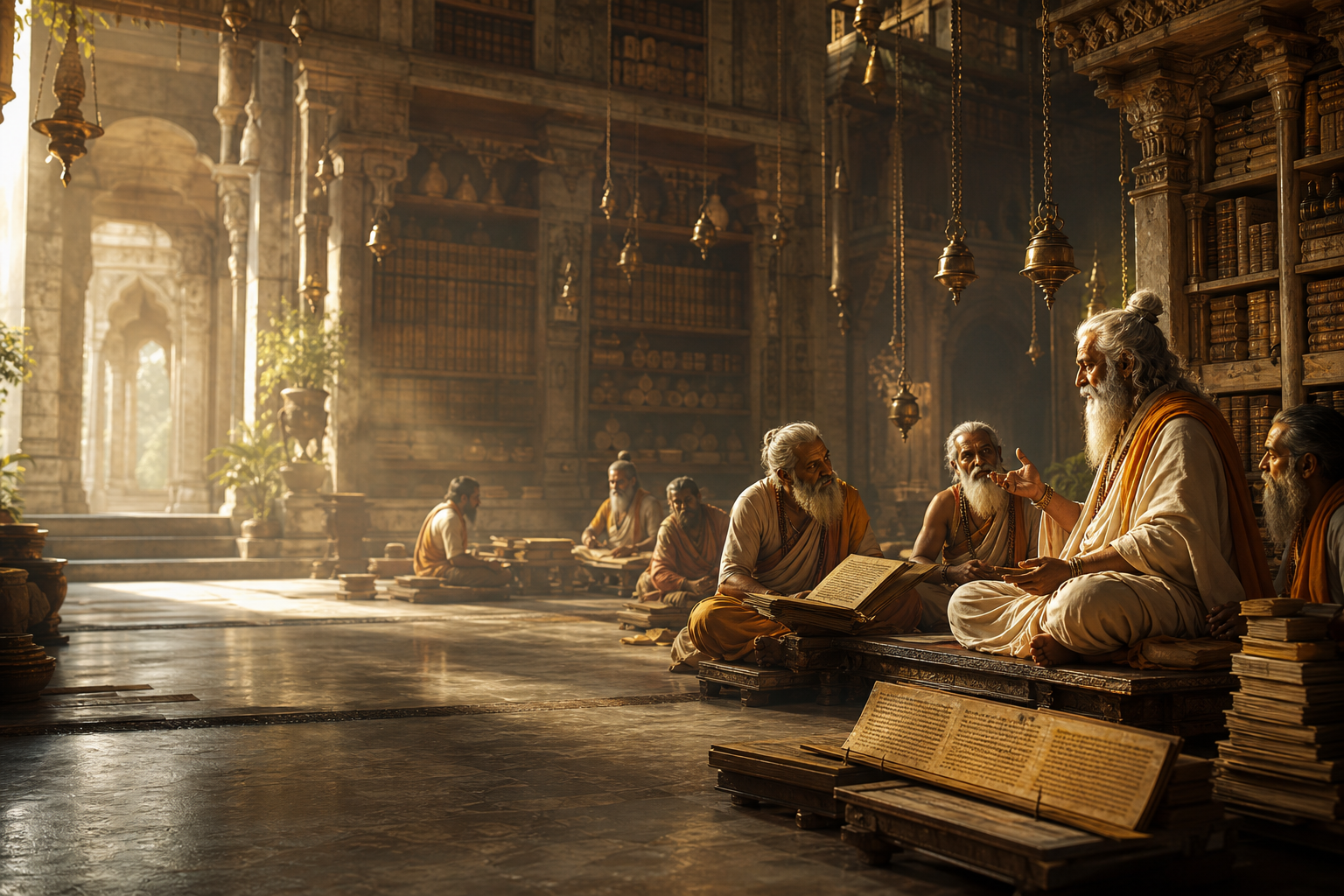
Teaching sages in an ancient scholarly setting
इतिहास

History

A dedicated section for the study of time, civilization, and world change, designed to feel as elegant on a phone as it does on a wide laptop display.

OriginsCivilizationsModern world

How to use it

A single history shelf.

One subject, one path, and a cleaner layout for smaller screens.

Quick access

History Cards

Each historical section becomes a card, and opens into a table.

Tap any card to reveal its structured table. The cards stay readable on mobile, while the tables remain horizontally scrollable if the content gets wide.

Cosmic Origins

The universe before civilization

A deep-time entry point from the birth of the universe to the formation of Earth.

Scope

Big Bang, cosmic evolution, and early Earth

Where history begins at the largest scale

Focus

Origins of matter, planet, and life

Sets the foundation for everything that follows

Open

/blog/history

Read the full history hub

Earth & Life Evolution

Planetary and biological change

From the shaping of the planet to the emergence of living systems.

Scope

Geology, atmosphere, oceans, and early biology

The long build-up to human presence

Focus

How Earth became habitable

Environmental context for later history

Open

/blog/history

Read the full history hub

Prehistoric Humanity

Before written record

A card for the earliest human communities, migrations, tools, and survival.

Scope

Hunter-gatherer life, movement, and adaptation

Humanity before cities and states

Focus

Tools, fire, cooperation, and learning

The social foundation of civilization

Open

/blog/history

Read the full history hub

Ancient Civilizations

Cities, empires, and records

A high-level view of early urban life, state formation, and written culture.

Scope

Mesopotamia, Egypt, the Indus world, and more

Early centers of organized life

Focus

Writing, law, trade, and ritual order

How institutions began to appear

Open

/blog/history

Read the full history hub

Classical Empires

Order at scale

The period where large political systems, philosophy, and cross-regional exchange accelerated.

Scope

Classical kingdoms, empires, and networks

Political order expands across regions

Focus

Administration, philosophy, and road systems

Power becomes organized and durable

Open

/blog/history

Read the full history hub

The Medieval World

Continuity, faith, and exchange

A bridge era shaped by trade, religion, scholarship, and political fragmentation.

Scope

Post-classical Europe, Asia, Africa, and the Islamic world

A connected medieval ecology

Focus

Learning, belief systems, and commercial routes

Knowledge and trade keep moving

Open

/blog/history

Read the full history hub

Age of Exploration

Routes across the world

Global navigation, maritime expansion, and the reshaping of contact between civilizations.

Scope

Oceanic travel, mapping, and encounter

Distance collapses under navigation

Focus

Ships, trade, colonization, and exchange

The world becomes more tightly linked

Open

/blog/history

Read the full history hub

Modern History & Revolutions

Ideas turning into systems

Industrial change, political revolutions, nation states, and global realignment.

Scope

Industrialization, revolutions, and modernization

Modern structures take shape

Focus

Mass politics, technology, and reform

New systems, new pressure

Open

/blog/history

Read the full history hub

Deep Dive into Indian History

Civilizational continuity

A focused lens on India’s long historical arc, from early culture to the modern nation.

Scope

Ancient, classical, medieval, and modern Indian history

A layered civilizational story

Focus

Dynasties, thought, society, and reform

Internal change across eras

Open

/blog/history

Read the full history hub

Country History

Comparative national narratives

A flexible card for country-level history: states, borders, political change, and identity.

Scope

National timelines and state formation

Use this as the country-level template

Focus

Borders, governance, conflict, and memory

Comparative history across nations

Open

/blog/history

Read the full history hub