Back to Mantras

Mantra

Yogena Chittasya | The Invocation to Patanjali

A bilingual reading of the Yogena Chittasya invocation, with the Sanskrit text, symbolic meanings, and a practical guide to chanting it before class.

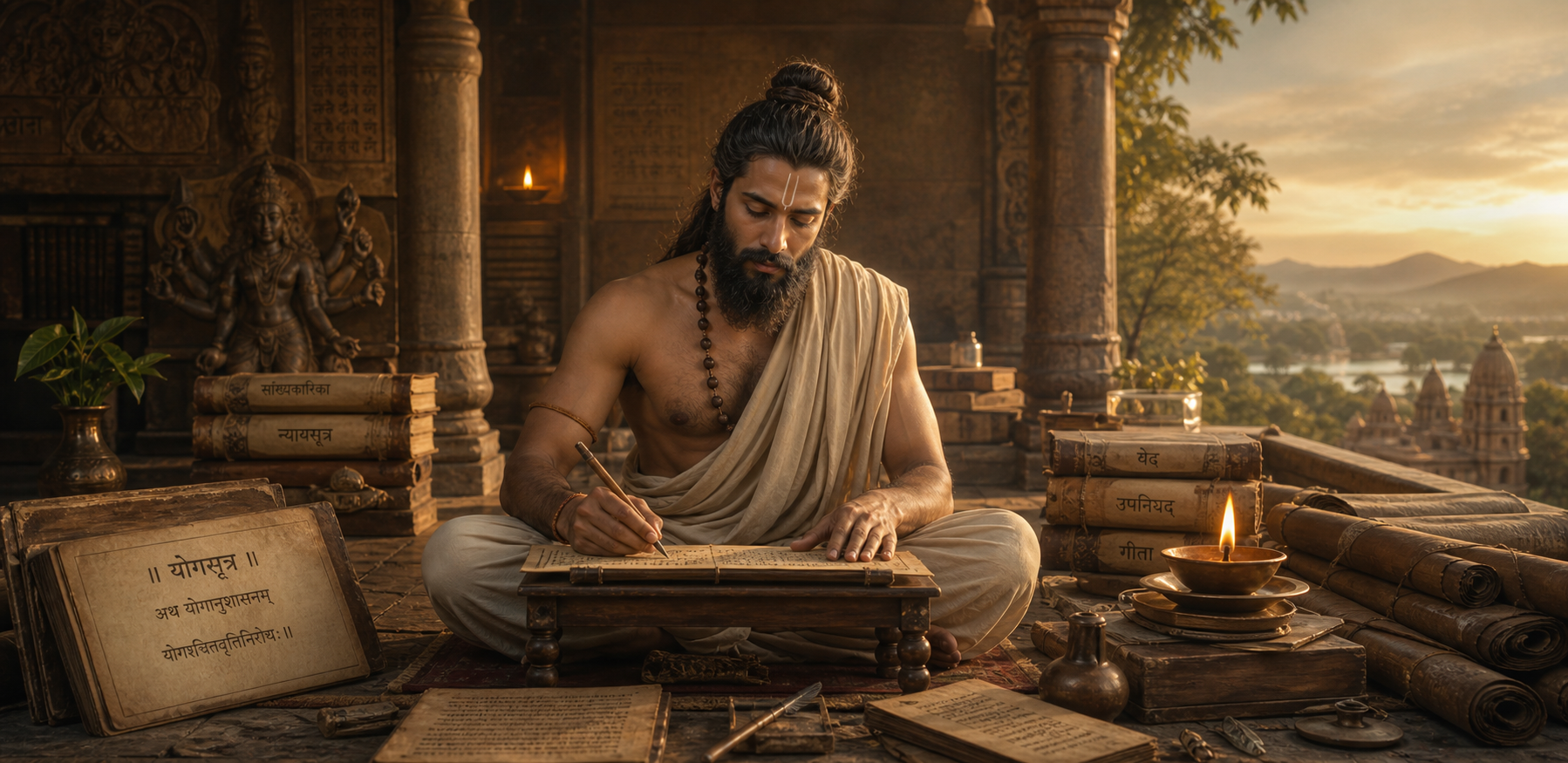
Patanjali in meditative form, symbolizing yoga, grammar, and medicine
Fixed formatEnglish / हिंदीTable of contentsVerse + meaning

Editorial

This invocation is often recited before a yoga class because it does more than praise a sage. It opens a practice by honoring Patanjali as a master of yoga, grammar, and medicine, then by contemplating his symbolic form: human above the waist, serpent below, and carrying the conch, discus, and sword. In a few lines, it aligns body, speech, and mind.

Ancient verse

Opening invocation

ॐ योगेन चित्तस्य पदेन वाचां। मलं शरीरस्य च वैद्यकेन॥ योऽपाकरोत्तं प्रवरं मुनीनां। पतञ्जलिं प्राञ्जलिरानतोऽस्मि॥

Aum Yogena chittasya padena vācāṁ malaṁ śarīrasya ca vaidyakena yo'pākarottaṁ pravaraṁ munīnāṁ patañjaliṁ prāñjalirānato'smi

Meaning in English

I bow to Patanjali, the foremost among sages, who cleanses the mind through yoga, the speech through grammar, and the body through medicine.

The opening stanza links yoga, grammar, and medicine as three forms of refinement: inner discipline, clear expression, and bodily care.

Symbolic form

आबहु पुरुषाकारं। शङ्खचक्रासि धारिणं॥ सहस्र शीरसं श्वेतं। प्रनमामि पतञ्जलिम्॥ ॐ शान्तिः शान्तिः शान्तिः ॐ॥

Ābahu puruṣākāraṁ śaṅkha cakrāsi dhāriṇaṁ sahasra śīrasaṁ śvetaṁ pranamāmi patañjalim aum śāntiḥ śāntiḥ śāntiḥ aum

Meaning in English

I bow to Patanjali, whose upper body is human, who bears the conch, discus, and sword, and who shines white with the endless thousand-headed serpent form behind him.

The imagery combines human mastery with cosmic symbolism. The conch awakens, the discus represents wisdom and authority, and the sword cuts through confusion and duality.

Section

Complete chant in one place

Keep the full invocation together before class.
ॐ

योगेन चित्तस्य पदेन वाचां।
मलं शरीरस्य च वैद्यकेन॥
योऽपाकरोत्तं प्रवरं मुनीनां।
पतञ्जलिं प्राञ्जलिरानतोऽस्मि॥

आबहु पुरुषाकारं।
शङ्खचक्रासि धारिणं॥
सहस्र शीरसं श्वेतं।
प्रनमामि पतञ्जलिम्॥

ॐ शान्तिः शान्तिः शान्तिः ॐ॥
Use this block when you want to recite the entire mantra in one place before practice or share it with someone who wants the full text.

Section

Why this invocation opens a yoga class

This chant is commonly placed at the beginning of a practice because it creates a clean threshold. It shifts the room from ordinary noise into attention, and from effort into reverence.
The invocation appears as the opening to the Bhoja Vrtti, a commentary on the Yoga Sutras associated with Raja Bhoja. That placement matters. It tells us that this is not decorative poetry. It is a gate into disciplined study.

Section

The three blessings named in the first stanza

The first half of the mantra praises three kinds of refinement at once: mind, speech, and body. In other words, it does not reduce yoga to posture alone.
Yoga quiets the mind. Grammar cleans up speech. Medicine repairs and supports the physical system. The invocation places all three inside one act of devotion, which is why it feels so complete.
  • Yoga: discipline for the mind and attention.
  • Grammar: precision and clarity in speech.
  • Medicine: care for the body and its balance.

Section

The second stanza and Patanjali’s symbolic form

The second half of the chant turns to Patanjali’s iconography. The human upper body points to conscious practice and discernment. The lower serpentine form connects him to Ananta or Adishesha, the endless cosmic serpent.
The conch, discus, and sword are not random decorations. They are symbols of awakening, mastery, and discrimination. The thousand heads suggest endlessness: reality that cannot be reduced to one small point of view.
  • Conch: the sound that awakens attention.
  • Discus: the sovereignty of wisdom.
  • Sword: discriminative insight that cuts through duality.
  • Thousand heads: endlessness, Ananta, and the cycle from which possibilities arise.

Section

How to chant it before practice

If you want to use the invocation well, do not rush it. Stand or sit tall. Let the breath settle. Recite it slowly enough that the sound becomes a deliberate transition rather than a performance.
The chant works best when the room is quiet and the mind is willing to receive it. In a real class, it marks the boundary between ordinary life and serious practice.
  • Pause before starting the first asana.
  • Keep the recitation steady and unforced.
  • Let the final silence matter as much as the words.

Section

Why it still matters now

Modern life is noisy, fragmented, and fast. A chant like this does not solve everything, but it changes the quality of entry. It asks you to begin with humility, not haste.
That is why the invocation survives. It reminds practitioners that yoga is not just exercise. It is a disciplined way of bringing mind, speech, and body into alignment before the work begins.

References used for the editorial direction

Bhoja Vrtti commentary on the Yoga Sutras
Yoga Sutras of Patanjali