
Back to Yoga

Mind as Bondage, Mind as Freedom: The Discipline of Inner Mastery

A premium bilingual Yoga lesson on why unobserved thought becomes bondage, and how abhyasa and vairagya turn the mind into a disciplined ally.

A meditator moving from mental darkness into calm light, symbolizing inner mastery
Fixed formatEnglish / हिंदीTable of contentsVerse + meaning

Editorial

Most people spend their lives obeying a voice they never chose. Yoga begins by challenging that assumption. You are not every thought that passes through your mind. You are the one who can observe those thoughts. The difference between those two positions is the difference between bondage and freedom.

Ancient verse

Yoga Sutra 1.4

वृत्तिसारूप्यमितरत्र।

vṛtti-sārūpyam itaratra

Meaning in English

Otherwise, the seer takes the same shape as the movements of the mind.

Unobserved thought is dangerous because it turns a mental event into identity. Yoga restores the distance needed for freedom.

Bhagavad Gita 6.5

उद्धरेदात्मनाऽत्मानं नात्मानमवसादयेत्. आत्मैव ह्यात्मनो बन्धुरात्मैव रिपुरात्मनः॥

uddhared ātmanātmānaṁ nātmānam avasādayet. ātmaiva hyātmano bandhur ātmaiva ripur ātmanaḥ.

Meaning in English

A person should lift themselves by themselves and should not pull themselves down; the self can be its own friend or its own enemy.

The Gita turns inner work into responsibility. You do not wait for rescue from outside; you train the self until it becomes supportive instead of destructive.

Yoga Sutra 1.12

अभ्यासवैराग्याभ्यां तन्निरोधः।

abhyāsa-vairāgyābhyāṁ tan-nirodhaḥ

Meaning in English

The stilling of the mind is achieved through practice and non-attachment.

Practice brings stability; non-attachment loosens obsession. Together they make the mind less reactive and more available to clarity.

Section

Opening

Most people live as if the mind is a private commentator they can never silence. It judges. It compares. It worries. It replays old mistakes. It predicts future disasters. Then, quietly, something dangerous happens: the voice stops sounding like a voice and starts sounding like identity.
Yoga begins by interrupting that habit. It does not ask you to destroy the mind. It asks you to stop mistaking every mental event for truth. That is where freedom begins: not in the absence of thought, but in the presence of awareness.

Section

A small experiment

Sit in silence for thirty seconds. Do not control the mind. Simply watch.
Notice how quickly attention runs somewhere else: a memory, a fear, a plan, a fantasy, a regret. The mind rarely stays where the body is. Most people discover something uncomfortable during this exercise: they control far less of their attention than they assumed.
That realization is not failure. It is the beginning of awareness. Once you see the drift, you can begin to train the return.

Section

The invisible prison

Bondage is rarely visible. Chains made of iron are easy to recognize. Chains made of habit are much harder.
A person can be financially successful, physically healthy, and socially respected while remaining trapped by fear, anger, comparison, and compulsive thinking. Yoga calls this unconscious identification. The prison is not the thought itself. The prison is believing every thought deserves obedience.
This is why disciplined attention matters. If you do not train the mind, it trains you.

Section

What Patanjali is actually saying

AI-generated portrait of Patanjali for a yoga lesson
Patanjali is not making a vague spiritual point. He is giving a direct diagnosis. Suffering often starts not because there are thoughts, but because we make thought our identity.
This is the decisive point. A thought is an event. A tendency is an event. A mood is an event. But the witness is not that event. Yoga teaches not to mix everything into "I".
If you can observe the movement, you are already more free from it. Then the mind no longer remains an infallible ruler.

Section

What the Gita adds to this

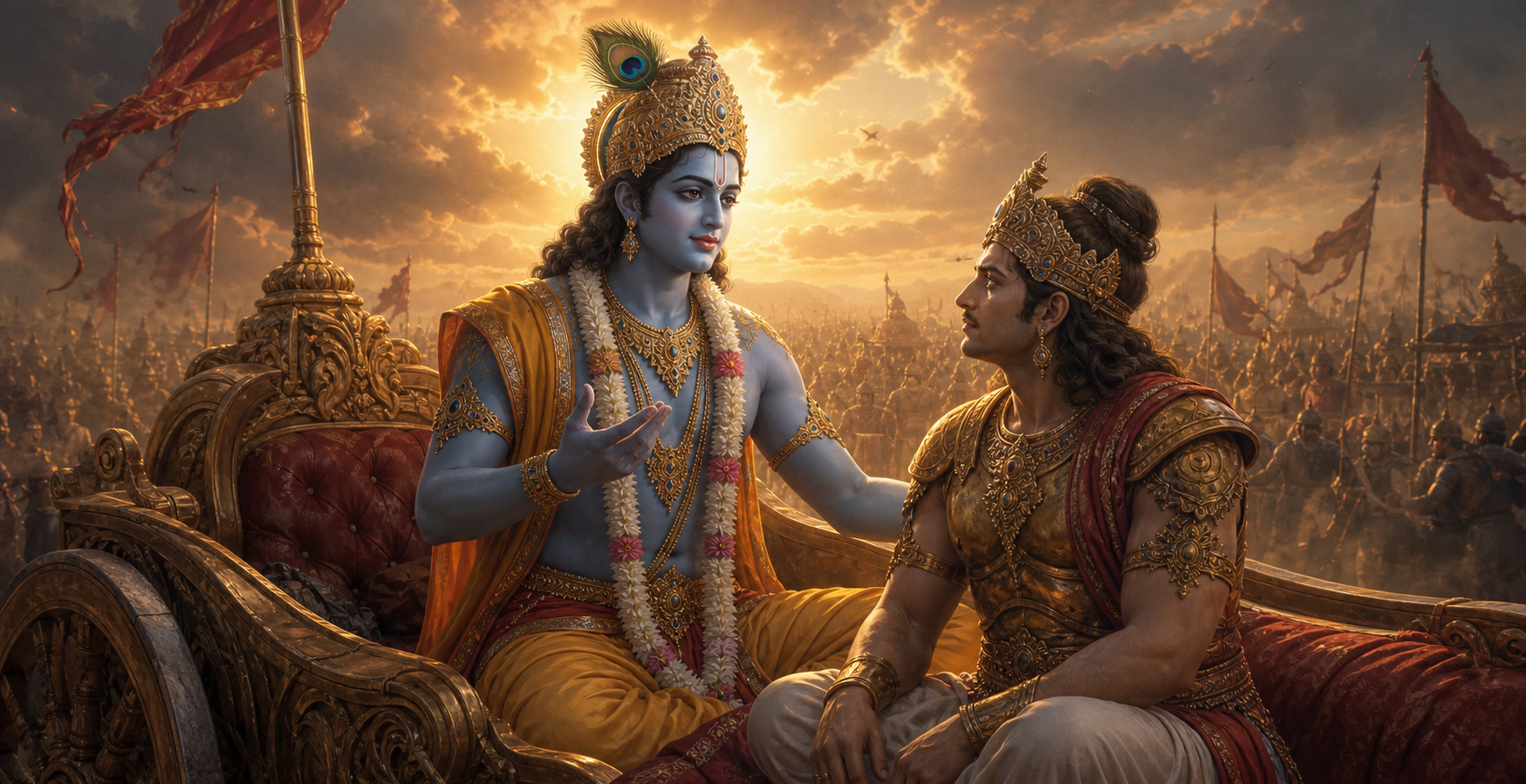
AI-generated battlefield image of Krishna and Arjuna
The battlefield of the Bhagavad Gita is not just Kurukshetra. It is also the human mind. Every day we face a choice: to strengthen courage or fear, discipline or impulse, awareness or distraction. What we nourish repeatedly becomes strong.
That is why Krishna’s message is not soft. It is precise. He demands neutrality in action, ego-lessness in effort, and avoidance of self-delusion in stability. The mind should be a servant to a higher purpose, not the ruler.
Inner discipline is not a fleeting state of mind. It is training. Returning again and again is necessary. Correction is necessary. Comeback is necessary.

Section

The two wings of Yoga

Patanjali offers two wings for inner freedom.
  • Abhyasa: Returning again and again to what matters.
  • Vairagya: Letting go of the need to control, grasp, or cling.
  • Practice without non-attachment becomes obsession.
  • Non-attachment without practice becomes passivity.
  • Both together create stability.

Section

The Witnessing state

Imagine you are standing by a river. Thoughts, emotions, memories, and impulses are flowing like water. Most people jump into the river and get swept away. The witness stands on the bank.
The river keeps flowing. But it no longer decides where the observer goes. This is the shift Yoga leads to: not numbness, not suppression, but a clear distance from the flow.
As soon as this distance is created, choice becomes possible again.

Section

Daily Practice: 3 Minutes for 7 Days

Perform this practice every morning or evening for the next seven days.
  • Sit in silence for three minutes.
  • Watch thoughts without suppressing them.
  • Label what comes: thinking, planning, memory, worry, judging.
  • Return attention to the breath.
  • Do not fight the mind. Train it.
  • The goal is not silence. The goal is awareness.

Section

Key takeaways

Keep these simple. If you can remember them, you can live them.
  • Thoughts are events, not identity.
  • Unobserved thinking creates bondage.
  • Awareness creates distance from mental reactions.
  • Practice builds stability.
  • Non-attachment reduces suffering.
  • The witnessing state is the foundation of inner freedom.
  • Yoga is a discipline of attention, not just physical exercise.

Section

Closing

Every human being contains both the potential for bondage and for freedom. The same mind that creates confusion can also create clarity. The same mind that gives fear can also give courage. The same mind that scatters attention can become the instrument of profound focus.
Yoga does not ask us to run from the mind. It asks us to understand it. Through observation, practice, and non-attachment, the mind gradually moves from ruler to servant.
When this happens, action becomes cleaner, judgment becomes sharper, and life becomes more purposeful. This is why the ancient masters placed such emphasis on training the mind. Protect your focus. It ultimately determines the quality of your life.

References used for the editorial direction